FORD 6A-D6DF-19A171-A Bronco Car Am Fm Radio 1970S Am/fm
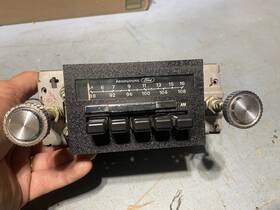
( Brand: Ford ), ( Manufacturer Part Number: 6A-D6DF-19A171-A ), ( Type: Radio ), ( Country Of Origin: United States )
Review FORD 1970s Series Truck Bronco Car Am/fm Radio
The **Ford 6A-D6DF-19A171-A AM/FM Radio** from the 1970s Bronco is a classic example of automotive radio engineering from an era when simplicity, durability, and analog clarity were paramount. This iconic unit, designed to fit seamlessly into the Bronco s rugged yet functional dashboard, represents a bygone era of automotive sound systems where reliability took precedence over modern digital sophistication. Crafted with a sturdy metal chassis and a robust front panel, this radio is built to withstand the demands of off-road adventures and daily commutes alike. The dials and knobs, though unadorned by flashy LED displays or touch-sensitive controls, are intuitively placed for effortless operation, allowing drivers to effortlessly tune into their favorite AM and FM stations with minimal effort. The tuning mechanism, likely featuring a classic analog dial with a smooth, weighted feel, ensures precise frequency selection, while the speaker output is designed to deliver crisp, clear audio that fills the Bronco s cabin with warmth and presence. This radio is not just a piece of functional equipment; it is a nostalgic artifact that embodies the spirit of 1970s automotive design where form and function were harmoniously balanced, and every component was engineered to endure. Whether installed in a restored showroom-worthy Bronco or a beloved project vehicle, this radio adds a touch of authenticity and character, serving as both a practical audio solution and a tangible connection to the golden age of American muscle and adventure.
### Pros and Cons of Buying a 1970s Ford Bronco with an AM/FM Radio
#### **Pros:**1. **Classic Design and Vibe** The 1970s Ford Bronco, particularly models from the early to mid-'70s, has a rugged, timeless appeal. Its boxy yet functional design reflects the era s off-road and outdoor adventure ethos, making it a nostalgic and visually distinctive vehicle.
2. **Off-Road Capability** The Bronco was originally built for rugged terrain, with features like solid axles, leaf springs, and a high ground clearance. While modern suspensions and tires may be outdated, it remains capable of handling trails, dirt roads, and light overlanding tasks, especially if restored or modified.
3. **Simplicity and Durability** Early 1970s Broncos often feature straightforward mechanical systems (e.g., carbureted engines, manual transmissions) that are easier to repair than modern electronics-heavy vehicles. Many components are still available or can be sourced from aftermarket suppliers.
4. **Low Cost of Ownership (If Well-Maintained)** Compared to modern vehicles, parts for a Bronco are relatively inexpensive, especially for common components like engines, transmissions, and suspension parts. Fuel efficiency is modest but not prohibitive for short to moderate distances.
5. **Community and Customization** The Bronco has a dedicated enthusiast community with access to restoration guides, parts, and modifications. Owners can easily customize their vehicles with aftermarket upgrades (e.g., lifted suspensions, modern engines, or modern comfort features) to suit their needs.
6. **Unique Driving Experience** The Bronco s solid-axle setup and manual transmission (if equipped) provide a more engaging, hands-on driving experience compared to modern vehicles with power steering and automatic transmissions. The ride can be bouncy, but it adds to the vehicle s character.
7. **Potential for Resale Value** Well-preserved or restored 1970s Broncos, especially rare or high-demand models (e.g., early 1970s with original features), can appreciate in value among collectors. However, this depends heavily on condition and provenance.
8. **Versatility** The Bronco s open cargo area and removable doors make it practical for hauling gear, camping equipment, or even small livestock. Its simplicity also allows for easy modifications for specific uses (e.g., overlanding, towing, or off-road racing).
---
#### **Cons:**1. **Outdated Safety Features** Modern safety standards (e.g., airbags, anti-lock brakes, electronic stability control, and crash-test ratings) are nonexistent or minimal in 1970s Broncos. The lack of these features increases the risk in collisions, especially in rollover situations.
2. **Poor Fuel Efficiency** Early 1970s Broncos typically have V8 engines (e.g., 300 or 351 CID) that guzzle gas, averaging around 10 15 miles per gallon in city driving. This can lead to higher operating costs, particularly for long-distance travel.
3. **Reliability Concerns** While some Broncos are well-maintained, many suffer from neglect, leading to issues like rust (especially in the frame and undercarriage), worn suspension components, or failing electrical systems. The AM/FM radio itself may be basic or prone to failure without modern upgrades.
4. **Limited Modern Comforts** Heating and cooling systems are often basic or nonexistent in older models. Interior materials (e.g., vinyl, carpet) may be worn or damaged, and modern amenities like Bluetooth, USB ports, or power windows are absent unless retrofitted.
5. **High Maintenance Requirements** Regular upkeep is essential to keep a Bronco running, including oil changes, brake inspections, and suspension work. Rust repair, especially in snowy or humid climates, can be costly and labor-intensive.
6. **Driving Comfort** The ride quality is harsh due to solid axles and leaf springs, which can lead to fatigue on long drives. Noise and vibration levels are higher than in modern vehicles, and road noise can be intrusive.
7. **Insurance and Registration Costs** Classic or vintage vehicles often carry higher insurance premiums due to their value and perceived risk. Registration fees may also be higher for non-standard or older models.
8. **Limited Availability of Original Parts** While aftermarket parts exist, finding original or high-quality reproduction parts for specific components (e.g., gauges, interior trim, or rare mechanical parts) can be difficult and expensive.
9. **Environmental and Emissions Concerns** Older vehicles do not meet modern emissions standards, which can limit where they can be driven (e.g., some cities or states have restrictions on pre-catalytic converter vehicles).
10. **Resale Depreciation** Unless the Bronco is a rare or highly sought-after model, its resale value may depreciate over time, especially if it requires extensive work to keep it running.
---
### **Conclusion:**Buying a 1970s Ford Bronco with an AM/FM radio is a unique and rewarding experience for those who appreciate classic vehicles, off-road capability, and hands-on maintenance. It offers a sense of nostalgia, durability in the right conditions, and a strong community for support and modifications. However, it comes with significant trade-offs in safety, comfort, fuel efficiency, and modern convenience. The Bronco is best suited for enthusiasts who prioritize character, functionality in specific environments (e.g., rural areas or trails), and are willing to invest time and effort into its upkeep.
---
### **Recommendation:** **Buy the Bronco if:**- You are an experienced mechanic or willing to learn to maintain it.
- You prioritize off-road capability, simplicity, and a classic driving experience over modern comforts.
- You plan to use it for specific purposes (e.g., overlanding, trail driving, or as a project vehicle) rather than daily commuting.
- You have access to a reliable mechanic or a supportive community for parts and advice.
- You are prepared for higher insurance costs and potential resale challenges.
**Avoid the Bronco if:**- You rely on the vehicle for daily commuting or long-distance travel due to its poor fuel efficiency and comfort.
- You cannot afford the maintenance costs or time required to keep it running reliably.
- You prioritize modern safety features, fuel economy, or low operating costs.
- You are not passionate about classic vehicles or off-roading, as the Bronco may frustrate you with its limitations.
**Alternative Considerations:**- If you love the Bronco s aesthetic but want modern reliability, consider a restored or heavily modified version with a modern engine, suspension, and safety upgrades.
- For a balance between classic appeal and practicality, explore other vintage trucks or SUVs (e.g., early Jeep Wranglers, Land Rovers, or restored muscle cars) that may offer better safety and comfort.
- If your goal is off-roading, evaluate modern overlanding vehicles (e.g., Toyota Tacoma, Jeep Wrangler, or Subaru Outback) that offer better safety and fuel efficiency while still providing rugged capability.
Ultimately, the Bronco is a fantastic choice for the right owner one who values its spirit over its shortcomings. For everyone else, it may be more trouble than it s worth.
Details:
Chrome coming off knobs. One untested fairly clean Ford truck radio. Sold for parts only and comes as seen. Buttons are not exactly working correctly but the on off volume tune knobs turn freely.
As seen number is 6A-D6DF-19A171-A.
part #: 6ad6df19a171 prices
- $25.00-$49.95
specifications indasuni:
- brand: Ford
- mpn: 6a-d6df-19a171-a
- type: Radio
- country of origin: United States
payments indasuni:
- other
- wallet: Apple-pay
- credit card: Visa
returns indasuni:
- policy: No Returns
offer indasuni:
- sold: 0
- availability: In Stock
- options: Ship-to-home
- quantity: 1
- started: June 9, 2026
general indasuni:
- Vehicle Electronics GPS > Car Audio > Car Audio In-Dash Units
- condition: For parts or not working
shipping indasuni:
- service: Economy
- class: Economy
- transit: 3-8 Days
- cost: $0.00
- type: Fixed
seller indasuni:
- # reviews: 3304
- city: Roaring River, North Carolina
- rating: 99.7%
Ford 6A-D6DF-19A171 Is Similar To:
- 1s4f-18c815-ab Ford Focus Am Fm Disc Cd Radio Receiver Oem Spring (27.7% similar) Matching the year and vehicle is not always enough because there may be several variations of part. Some will simply plug n play. This includes some radios, air bag modules, and computers. As is parts are just like it says and not returnable for any reason. Don't need the whole thing. Gets you ...(December 17th, 2018)
- 2m5v-18c815-bd Ford Focus Disc Cd Factory Player Radio (31.9% similar) Works perfectly, very clean...(July 29th, 2018)
- 3f23-18c858-ad Ford Freestar Mercury Monterey Rear Climate Radio Controls (27.5% similar) If you do not have this exact part number currently in your vehicle, it will likely work. The part number is 3F23-18C858-AD. 90 warranty included. This unit is being sold as a replacement only. Please verify that this is the item you require before purchase. The item is in decent cosmetic condition ...(July 22nd, 2018)
- 3f2t-19b132-ba Ford Truck Van Amfm Radio Cs Cd Control 00842582101993 (34.3% similar) Part number is 3F2T-19B132-BA. Life is short. Buy smart the first time. Check the chart for compatibility and confirm your plugs a sure, plug play fit. Operation of the iPod jack is a snap. I was amazed after some searches at the pricing and quality seeing of factory car radios on. Some of our ...(December 5th, 2018)
- 3w3t-18c868-aa Ford Lincoln Town Car Grand Marquis Oem Radio Cd Player (31.1% similar) Part model 3W3T-18C868-AA make sure it is the right one for your car see numbers and photos connections condition. Not tested, fm working. Factory Ford radio CD player...(January 9th, 2019)
- 4c3t-18c815-aa Ford Escape Player Radio Oem (27.8% similar) Hybrid am-fm-CD 6 disc, in dash, id 2C3T-18C815-AA Ford pickup F250SD super duty changer 4C3T-18C815-AA F550SD disc 3C3T-18C815-AA 3C3T-18C815-AB and ac mercury mariner F450SD 3C3T-C815-AA worked perfectly at the time. Not known if this is the case with unit, but Ford dealers can unlock stereos. ...(September 20th, 2018)
- 4l2t-18c868-ba Ford Explorer Sport Trac Factory Cd Cassette Player Radio (35% similar) It is fully tested to ensure all functions and illumination work absolutely flawless. May possibly fit other Ford Lincoln or mercury vehicles and years such as ranger others long they have two black plugs mount using the side locking clips. Listing is for radio only no wiring. This should work for ...(April 28th, 2018)
- 5l3t-18c869 Af Ford Factory Am Fm Cd Radio (33.6% similar) Please see photos. Ford F-150 factory am fm CD radio 5L3T-18C869 AF: used, good physical condition. No manual, cables, or other accessories. Accessories: none. I forgot to test it before pulled out of the truck. It came out of a used truck that I purchased. The radio works. I never used the CD ...(March 28th, 2019)
- 5l8t-18c868-ba Ford Ranger Explorer Windstar Radio Cd Cassette (28.3% similar) See photos for details...(September 6th, 2018)
- 6c3t-18k810-ab Ford Radio Am Fm Aux Input Bluetooth Brand 00842582137107 (14.6% similar) 2006 Ford F250SD F350SD radio am fm aux input Bluetooth 6C3T-18K810-AB brand new - F350D MP3 single disc CD receiver w and streaming music for use with iPod, iPad, iPhone, player, Sirius XML satellite, android phone more. The appearance of this radio is in decent condition with minor wear as ...(November 5th, 2018)
- 6l2t-18c869-ak Ford Stock Oem Factory Radio Head Unit (27.1% similar) Was removed from a 2007 Ford explorer that is still being used, not wrecked car. No scratches, cracks or break. Part number 6L2T-18C869-AK. No wiring or hardware included. Ford mercury stock oem factory am fm CD radio head unit explorer mountaineer genuine part. That part number corresponds with ...(August 18th, 2018)
